


Coercive Control
Recognising the signs and finding support
Abuse isn’t always physical. Sometimes it’s a pattern of behaviour that takes away your freedom, independence and sense of safety.
What is coercive control?
Coercive control is a form of family violence where one person uses a pattern of threatening, intimidating, manipulative or controlling behaviours to gain power over another person.
It can happen gradually, making it difficult to recognise. What may begin as jealousy, constant checking in or making decisions for you can develop into a pattern of control that affects almost every part of your life.
Unlike physical violence, coercive control often leaves no visible injuries. But its impact can be just as serious.
Over time, someone experiencing coercive control may feel isolated, fearful, confused or trapped, as though they are constantly walking on eggshells.
You don’t have to experience physical violence for a relationship to be abusive.
Signs of coercive control?
Coercive control can take many forms. Some common signs include:
- Isolation: Preventing you from seeing friends or family, or making it difficult to maintain relationships and support networks.
- Monitoring and surveillance: Constantly checking where you are, who you’re with, your phone, messages or social media, or tracking your movements.
- Financial control: Restricting access to money, preventing you from working or making you financially dependent.
- Emotional and psychological abuse: Repeated criticism, humiliation, manipulation, blame or making you doubt your own experiences.
- Threats and intimidation: Threatening to hurt you, your children, pets or themselves, or using fear to control your decisions.
- Controlling everyday life: Dictating what you wear, where you go, who you speak to or how you spend your time.
- Sexual coercion: Pressuring, threatening or forcing you into sexual activity without your freely given consent.
- Using children: Threatening to take your children away, using them to monitor you or manipulating parenting arrangements to maintain control.
These behaviours may seem small when viewed individually, but together they can create a pattern of fear and control.
The invisible barriers that make leaving difficult
People sometimes ask, “Why don’t they just leave?”
For someone experiencing coercive control, leaving may not be simple or safe.
Threats, financial dependence, isolation, fear for children or pets, and ongoing intimidation can create invisible barriers that make it extremely difficult to seek help or leave a relationship.
A person may fear what will happen if they try to leave, or may have had their confidence and independence gradually undermined.
Coercive control can also continue after separation through stalking, harassment, threats or misuse of parenting and legal processes.
No one should be blamed for staying in an abusive relationship. The responsibility for abuse always lies with the person choosing to use it.

Concerned about someone?
Coercive control can be difficult to recognise from the outside.
You may notice that a friend, family member or colleague has become withdrawn, seems anxious about upsetting their partner, has limited access to money or frequently changes plans because of their partner’s demands.
If you’re concerned:
- Listen without judgement.
- Let them know you care and that support is available.
- Avoid pressuring them to leave or making decisions for them.
- Respect their choices and confidentiality.
- Encourage them to seek specialist advice when it is safe to do so.
Even a simple conversation can help someone feel less isolated.
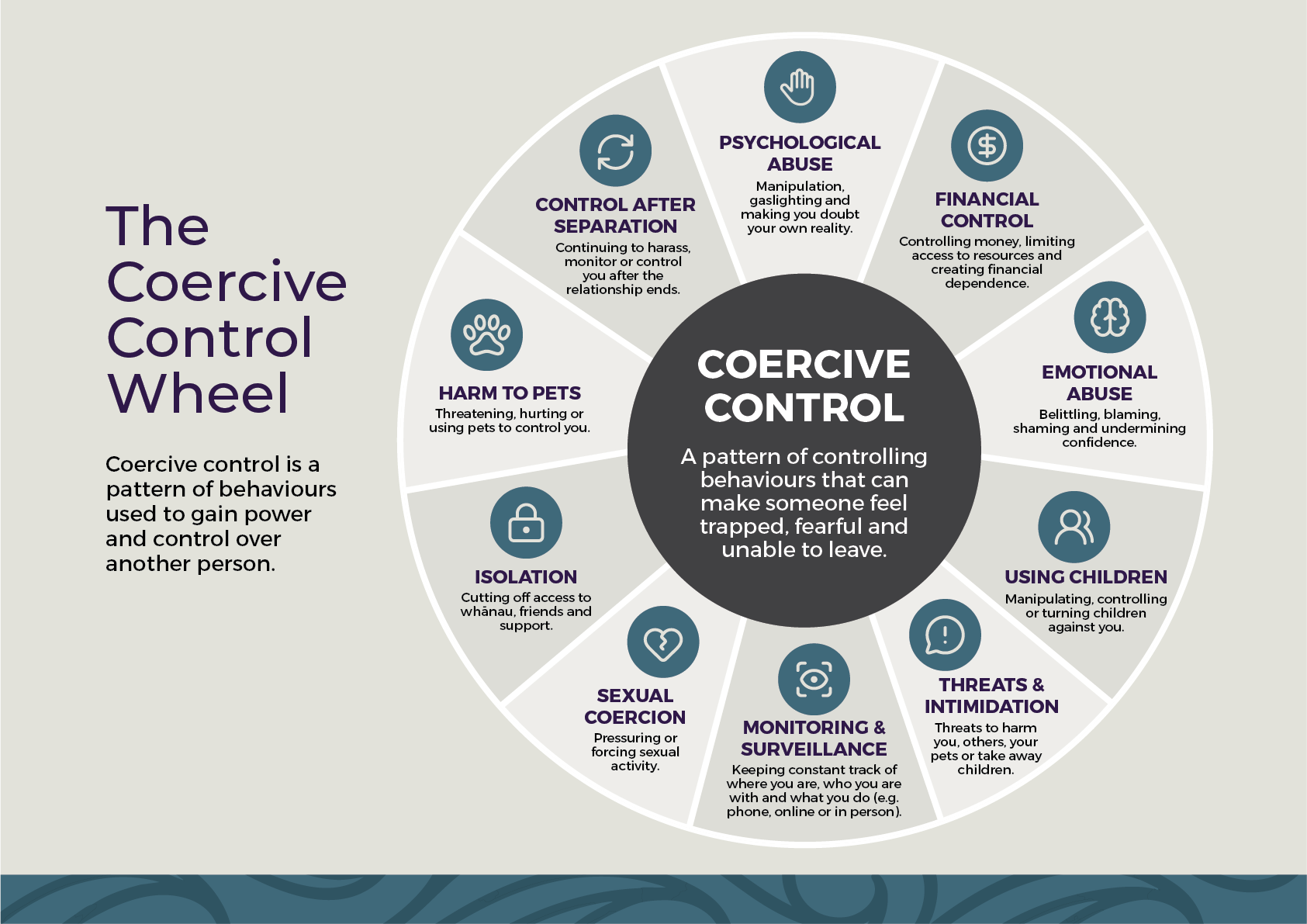
Adapted from coercive control resources by Debbs Murray, ECLIPSE Family Violence Services.
You don’t have to face it alone
If you recognise any of these behaviours in your relationship, or are worried about someone you know, Tauranga Women’s Refuge is here to help.
We provide confidential information, support, advocacy and safety planning for women and children experiencing family violence.
You don’t have to be ready to leave a relationship to ask for help. We can talk through your concerns and help you explore your options at your own pace.
24/7 Helpline – 0800 867 338 (0800 TO REFUGE)
If you or someone else is in immediate danger, call 111.